
I am often told that various of our experiments produced results confirming the obvious. Such comments never come from people working in quantitative finance. Finding “patterns” that don’t exist is something we quants also do if not careful. The key is to constantly test hypotheses. This post will describe one such effort and where it led.
Some clients prefer that we handle all of their assets, whereas others may self-manage a portion if interested in stocks and markets. This can be a collaborative effort, and we are often humbled by what our insider clients can discern. Sometimes we act on the results.
One question that slowly took root was whether insiders perform better when more actively trading their own company shares. The literature had not posed this question, so we started in 2008 with a binomial distribution approach, with an updated 2016 version shown below. Lumping buys and sales together, and positing that monkeys had 50% odds of beating a sector index on buys or sales, or, e.g., 12.5% odds of going three for three, we sorted insiders by how many times they had traded and whether they had beaten a sector or major industry index. The results seemed clear. Whether trading flawlessly or underperforming in one or more transactions, insiders trading more than once appeared significantly more likely to outperform single-time transactors, a pattern continuing the more an insider traded. This was our initial thinking on trading frequency vs performance.
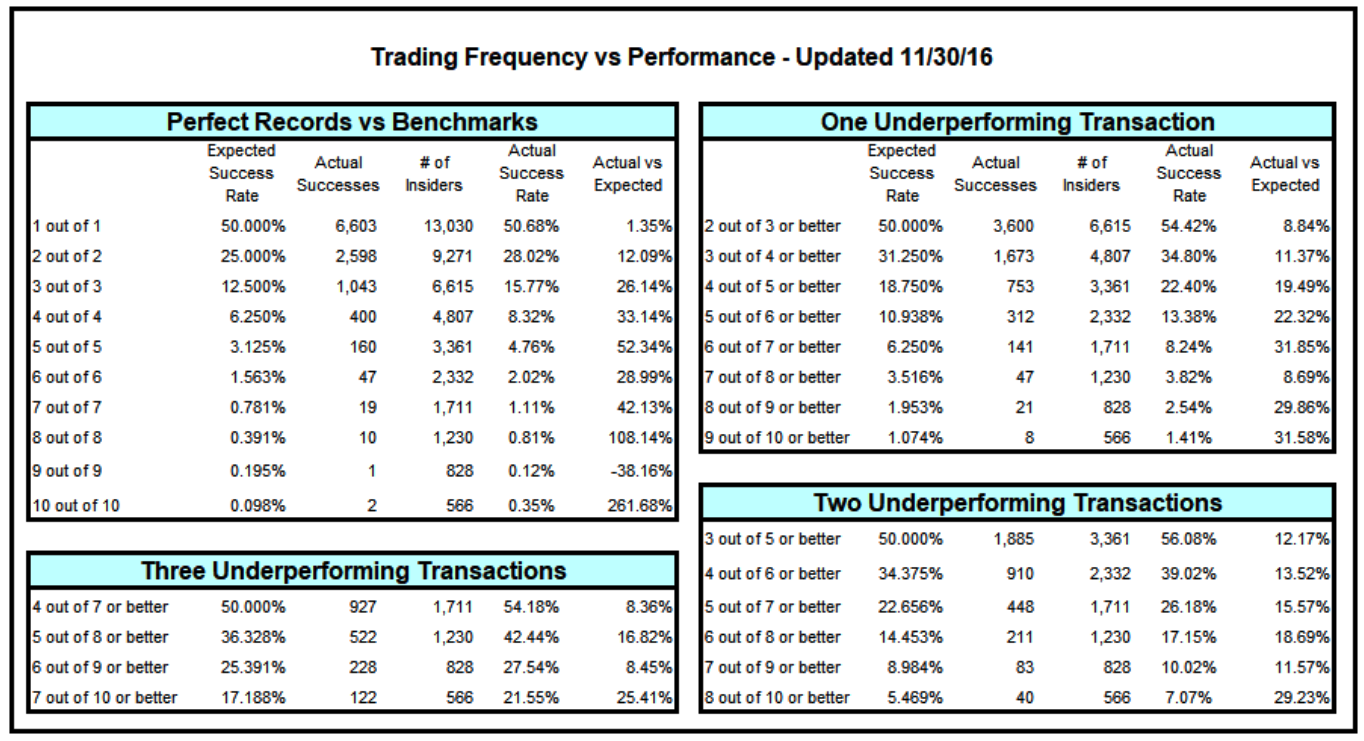
Wanting to incorporate this into an algorithm, we vetted the additional concern that early successful traders perhaps continued trading while underperformers dropped out. Such a survivor bias could have caused misleadingly positive showings of a correlation between trading frequency and performance, but we were pleased to find that insiders improved over successive transactions.
Our next question became how much importance to place on frequent transactors, especially those with stronger records. I asked a UC Berkeley PhD intern to develop a weighting schema based on the likelihood that a given insider would outperform on a future trade, and when he hesitated, I pushed. One week later, he produced a model wherein our “best” insider (at that time, in 2008, an insider who had beaten benchmarks seven out of seven times) was accorded 100% odds of going eight for eight if trading again.
I was unnerved. If 100% were credible, which it wasn’t, shouldn’t all investment money go into that insider’s next trade? Clearly, we were not going to do that. My common-sense instinct, based on having experienced many stocks in their consistent unpredictability, was that an exceptional insider who had gone seven out of seven might have 65% odds of beating their next benchmark. But what basis did we have for any weightings? I made an important decision not to use these observations until I could understand them better, and to understand them better by stepping back and more thoroughly studying insider trading from as many standpoints as possible.
It was the smart call.
Returning more deliberately to the trading-frequency-vs-performance question in 2020, we examined acquirers and sellers separately, and a more interesting tableau emerged. Applying a time series approach, we discovered that insiders got worse at acquiring shares while improving over subsequent sales. Our hunch is that insiders with no interest in trading sometimes get drawn in by exceptional opportunities, and their ability to repeat the original performance is limited. Sellers, meanwhile, start with overconcentrated stakes where diversifying rather than price seeking may be the rational decision. After some initial sales, they can afford to seek better exit timing.
Using non-transactional filings (grants, awards, gifts, share retitlings, etc) to establish each insider’s tenure at a company, we additionally discovered that insiders who trade more frequently perform less well, the opposite of what we had supposed. As an analogy, readers might stop to consider how many genuinely ‘good’ business ideas they’ve had in their lives, whether acting on them or not. Most people have few if any. We similarly find that a uniquely good trading opportunity for an insider – essentially a business decision – is rare.
Tackling unasked questions is exciting, as is applying the occasional worthwhile finding to our portfolios. One unexpected outcome of this effort was a career trajectory change for an intern, Huansong Li, who became a coauthor on our paper. Huansong had completed his master’s in statistics at Columbia before interning at Global and had intended to work in industry but got deeply pulled into unraveling the frequency-vs-performance question. We had him present at an academic conference, and he is currently pursuing a PhD at the University of Texas, targeting an academic career.